Womersley Number: Fundamentals and Application in the Context of Fluid Power Systems

The Womersley number (Wo) is a dimensionless parameter in fluid mechanics that describes the ratio of inertial to viscous forces in oscillatory flows. It is particularly relevant for the analysis of unsteady (time-dependent) flows in piping systems, as commonly found in hydraulic and pneumatic applications.
Applications in Piping System Simulations
- Dynamic Flows in Pulsating Systems
In many fluid power systems, such as hydraulic drives or pulsation dampers, periodic pressure and flow fluctuations occur. The Womersley number helps determine whether the flow behavior is dominated by inertial or viscous effects, which is critical for understanding and optimizing system performance. - Analysis of Fluid-Structure Interactions in Flexible Piping Systems
In systems with rapid pressure variations, such as fuel lines or blood vessels in medical applications, the Womersley number plays a crucial role in predicting wall interactions and pressure losses, enabling more accurate modeling of transient flow behaviors. - Optimization of Piping Systems
In simulations, incorporating the Womersley number allows for a more realistic modeling of unsteady flows, especially in high-frequency systems with rapid pressure changes. This enables more precise analysis and optimization of pressure losses, flow-induced vibrations, and system efficiency.
The Womersley number is a key parameter for the analysis and simulation of time-dependent flow phenomena in fluid power systems. Its application in 1D-CFD simulations, such as those performed with DSHplus, enables a detailed evaluation of dynamic effects, contributing to the optimized design and efficiency of piping systems.
Theoretical Background
The Womersley number \(Wo\), named after the British mathematician John R. Womersley, indicates the ratio of inertial forces to viscous forces in harmonically oscillating pipe flows:
$$Wo = \frac{d}{2}\sqrt{\frac{\omega}{\nu}}.$$
The radial distribution of axial velocity in the pipe is strongly influenced by the Womersley number in oscillating pipe flow.
For a given volume flow wave amplitude \(\delta Q\), the velocity profile is given by the following equation:
$$\delta u(r,t) = \frac{\delta Q}{A}\frac{I_0(R_a) - I_0(R)}{I_2(R_a)}e^{i\omega t}$$
Here, \(A\) denotes the cross-sectional area of the pipe through which the flow passes, \(I_n(x)\) denotes the modified Bessel function of the first kind and \(n\)th order, and \(R\) denotes the radial coordinate made dimensionless by the angular frequency \(\omega\) and the kinematic viscosity \(\nu\). The dimensionless radial coordinate can be expressed by the Womersley number:
$$R = r\sqrt{\frac{i\omega}{\nu}} = \frac{r}{r_a}Wo\sqrt{i}$$
The influence of the Womersley number on the velocity profile is visualized in the following figure:
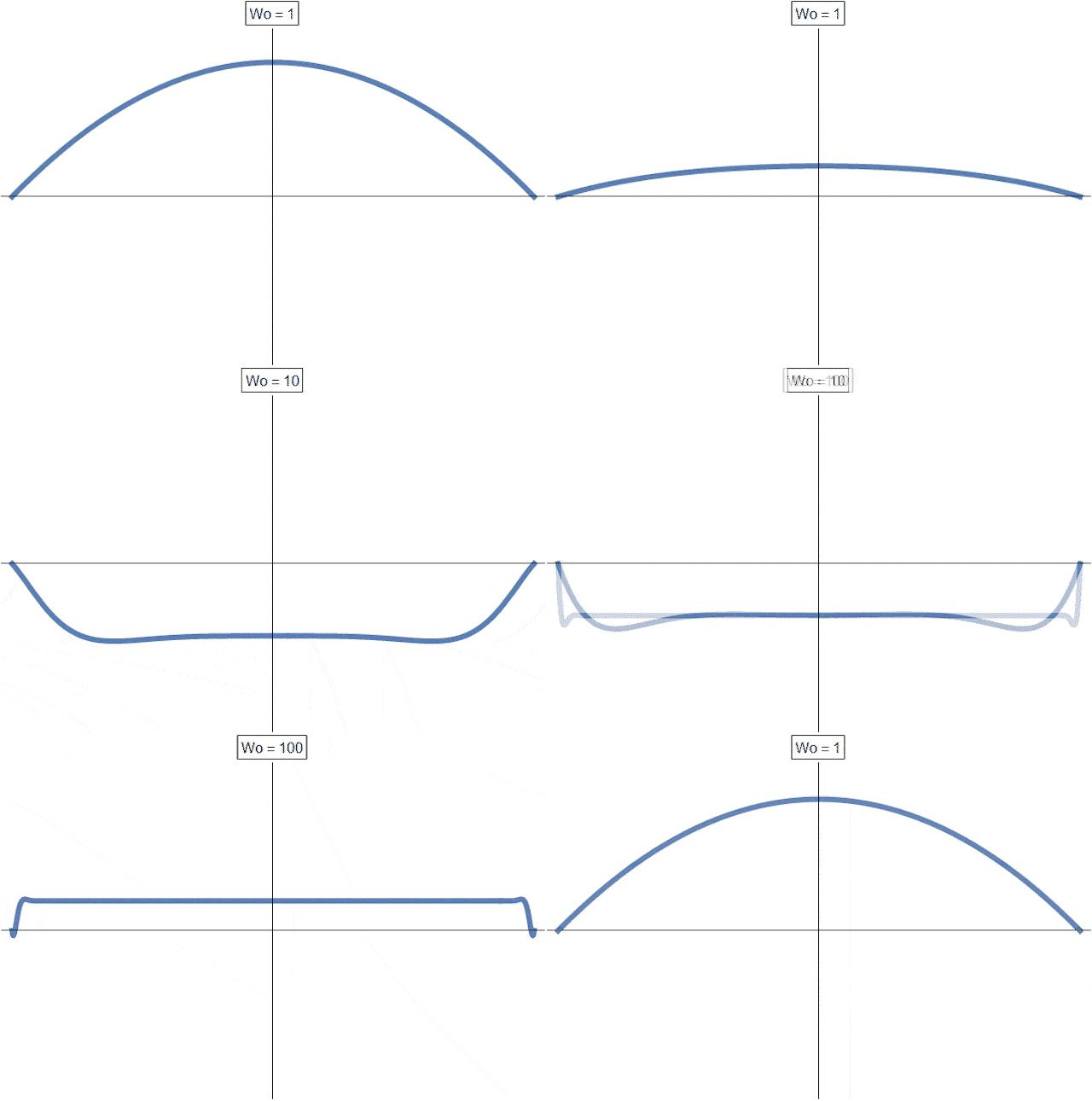
For very small Womersley numbers, the velocity profile transitions into the POISEUILLE parabola known from steady pipe flow. As the Womersley number increases (corresponding to an increasing frequency \(\omega\) with the test setup otherwise remaining unchanged), the velocity profile becomes fuller. For very large Womersley numbers, velocity peaks can be observed near the wall, which precede the core flow. This phenomenon is referred to in the literature as the Richardson annular effect.
Interesting Facts
Since the Womersley number can also be interpreted as the Reynolds number for unsteady flows, the term dynamic Reynolds number is also commonly used. The Valensi number \(Va\), which is also used to characterize the influence of frequency, corresponds to the square of the Womersley number.