


FLUIDON News: Latest Infos and Updates
30.11.2021
Exported DSHplus models can be run on all platforms without a licence. On 12 November, the new version 3.13 of the DSHplus simulation environment was released.
This new release focuses on innovations with regard to the runnability of exported DSHplus models, numerical stability, and the integration of nested FMUs (Functional Mock-up Units) into the VEL (Virtual Engineering Lab) real-time system.
"We are pleased to make the new release 3.13 of DSHplus now available to our customers," says Oliver Breuer, Head of Software Engineering at FLUIDON GmbH. "The barrier-free runnability of DSHplus models on other platforms and their integrability without additional costs holds great potential, especially for interdisciplinary engineering projects. We have again increased the numerical stability enabling users to calculate multi-layered models without interference. In this way, we prevent complex solution approaches from being narrowed down at an early stage. It is important to us to support the genius of the developer in the best possible way."
15.06.2021
Free webinar | June 24, 2021 | 10:00 am EDT | Duration: 30 minutes
In this webinar, we will show you how to optimize your control strategies with the Virtual Engineering Lab (VEL). The webinar is part of the "Simulate & Optimize Manufacturing Processes" event series from our partner Altair.
Simulation-based digital twins produce accurate representations of the machine’s behavior and performance. Those digital twins - e.g. created with Altair Activate or DSHplus - can be used for validation of control code if they can be calculated and visualized in real-time. Fluidon’s virtual engineering lab (VEL) implements digital twins via functional mock-up interface, calculates and visualizes them in real-time and connects to any controller hardware used for control code development. By linking digital twins with the control code, the VEL contributes to a holistic system understanding. This webinar uses the example of an excavator to show how a simulation-based digital twin can be created and implemented in the VEL. Then in the next step the control algorithm for a bucket grading operation is developed and tested – all before the excavator goes into service.
Presenter: Dr. Torsten Verkoyen | Managing Partner, Fluidon
01.12.2020
FLUIDON releases new version DSHplus 3.12. The focus is on innovations in the interface area Functional Mock-up Interface (FMI) according to Standard 2.0.
IMPORT OF FUNCTIONAL MOCK-UP UNITS (FMU) to FMI 2.0
In addition to the already existing FMI export for DSHplus models, FMUs from any simulation program can now be embedded into DSHplus models. The FMI compatibility, which is now given in both directions, enables model exchange with project partners and customers. In its function as co-simulation master, DSHplus supports the modeling of complex systems. In order to significantly reduce the computing time of large models with several FMUs, the calculation can be performed in parallel.
EDITABLE PARAMETERS of DSHplus-FMU
In order to adjust the system even after the export has been completed, the parameters of the FMU exported by DSHplus can be edited in the importing tool. This eliminates the effort for a new export.
EXPORT OF SEVERAL PARAMETER sets for external batch processing
When exporting DSHplus models for calculation with DSHcalc, it is now possible to export several parameter sets simultaneously. The model is then ready for an automated simulation of all parameter sets to perform variant calculations without further processing.
12.02.2020
The recording of the successful webinar "Simulation of cavitating flows and gas bubble transport" is now available online.
Obviously we hit a nerve with our last webinar. Many developers are struggling with the cavitation that occurs in piping systems and its negative effects on the performance of hydraulic systems.
Due to the ongoing discussion and the strong interest in this topic we have now put the recording of the complete webinar online.
There, the viewer learns in a total of four videos how cavitation-prone hydraulic systems are simulated with DSHplus. All relevant steps from model construction to result analysis are explained:
- What types of cavitation can be distinguished and how are they modeled?
- How is the transport of gas bubbles modeled?
- Which fluid properties must be known in order to perform cavitation calculations?
- How are cavitation-endangered hydraulic systems simulated with DSHplus? The webinar covers the relevant steps from model set-up to result analysis.
- What conclusions can be drawn from the simulation results?
14.11.2019
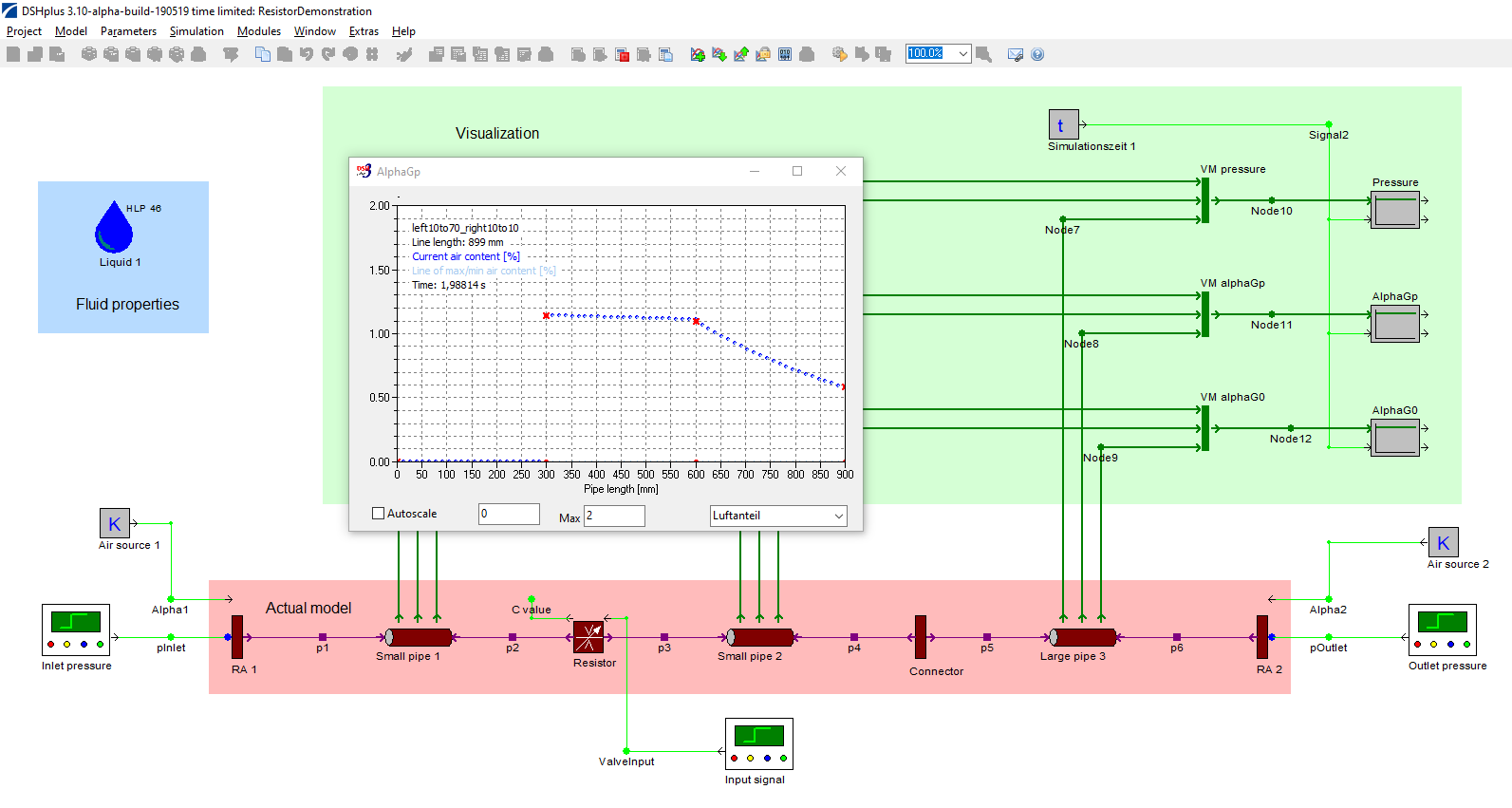
DSHplus 3.11 is available in the download area.
The installation file contains the complete program. By assigning a valid license key, DSHplus 3.11 starts with your user profile. If you do not have a license key, DSHplus 3.11 starts as Personal Edition.
12.11.2019
Free live webinar on 26 November 2019 at 16:00. More information on content and registration:
The occurrence of cavitation negatively affects the performance of hydraulic systems. The impairments range from increased noise levels to severe and life-limiting wear of machine parts. Cavitation in hydraulic systems can be prevented by early integration of one-dimensional fluid power simulation software into the design process.
In this webinar, FLUIDON’s piping expert “RohrLEx” explains how cavitating flows can be simulated with the updated component models of DSHplus. The improved models enable the user to analyze all relevant types of cavitation – vapor cavitation, gas cavitation and pseudo-cavitation – as well as the associated phenomenon of gas bubble transport.
To illustrate the workflow when simulating a cavitation-endangered and/or gas conveying system with DSHplus, two exemplary cases are presented and discussed.
Webinar Outline
What types of cavitation can be distinguished and how are they modeled?
How is the transport of gas bubbles modeled?
Which fluid properties must be known in order to perform cavitation calculations?
How are cavitation-endangered hydraulic systems simulated with DSHplus? The webinar covers the relevant steps from model set-up to result analysis.
What conclusions can be drawn from the simulation results?
Who Should Attend?
The webinar offers valuable insights into the simulation of cavitating flows for any engineer involved dealing with pipelines, hoses or piping systems, irrespective of the material, cross-section shape or size, pipe length or type of fluid. The target audience ranges from fluid power engineers to professionals from Automotive Engineering, Aerospace Engineering, Marine Engineering and Manufacturing to Biomedical Technology.
09.09.2019
Users can now benefit from a new fluid property handling and many more enhancements in DSHplus 3.10
Aachen, Germany, September 10, 2019 - FLUIDON GmbH, the experienced service provider for simulation and analysis of fluid power and mechatronic systems, announced today the release of the new version 3.10 of its simulation environment DSHplus. Starting today, DSHplus users with a valid maintenance contract will automatically receive new license keys. The new version will also be available for download on the FLUIDON web page.
New fluid property handling in DSHplus 3.10
With the new version FLUIDON introduces a new fluid property handling that allows users – in contrast to past versions – to include their own fluid property descriptions. In addition, the Bunsen coefficient (a measure of the gas dissolving capacity of a liquid) and the vapour pressure curve have been added as new material properties. With knowledge of the vapour pressure and the Bunsen coefficient, the pressure-dependent growth and transport of vapour and/or gas bubbles in liquid-filled pipe systems can be considered.
Improved simulation of gas and steam cavitation in pressure oscillation investigations
In particular, the simulation of pressure oscillation and water hammer problems benefits from the improved modelling, as – depending on the pressure level – the occurrence of gas and/or steam cavitation is to be expected. The correspondingly extended DSHplus pipe models have been validated based on published reference experiments. Also, the tried and tested models of DSHplus can now take the mechanical effects of water hammer or pressure pulsations on piping components into account by enabling the consideration of fluid-structure interaction (FSI library) during a 1D hydraulic simulation.
FMI 2.0 standard to replace DSHplus-STC for simulation tool coupling
In addition, the new version introduces the Functional Mockup Interface (FMI) 2.0 standard, replacing the former DSHplus-STC (Simulation-Tool-Chain) for simulation tool coupling. The Functional Mockup Interface is a tool independent standard for coupled simulations and supports model exchange as well as co-simulation.
11.07.2019
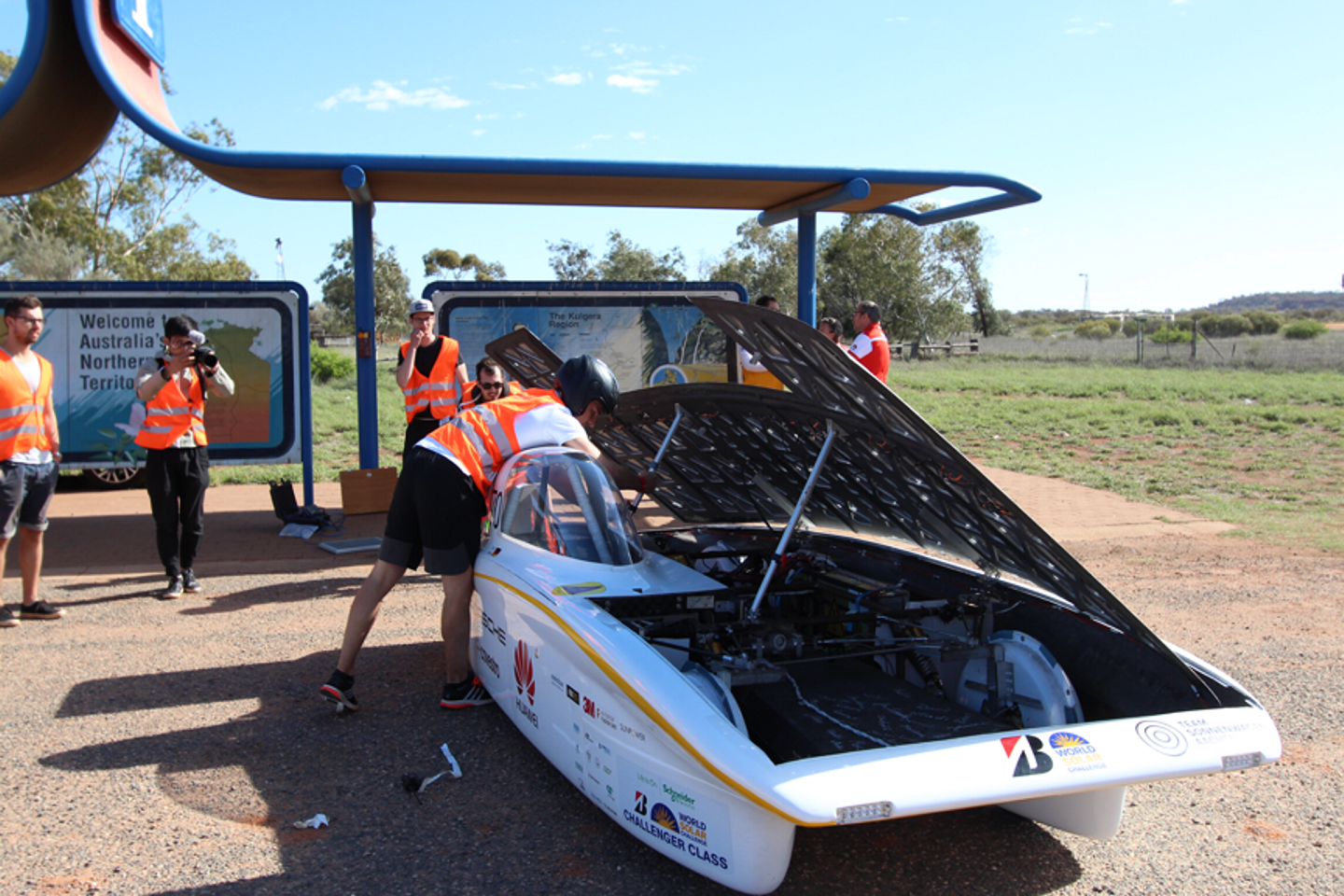
FLUIDON supports the participation of the Sonnenwagen team in the Solar World Challenge
Many topics have little or no relation to one's own work. Some even compete with own projects and inspire us the more. We are pleased when other teams think courageously and seek alternative solutions. The FLUIDON team supports and donates for the Sonnenwagen project. Team Sonnenwagen from Aachen starts at the World Solar Challenge. This is the toughest solar car race in the world: From Darwin to Adelaide - 3022 km through the Australian continent only with the power of the sun. It's great.